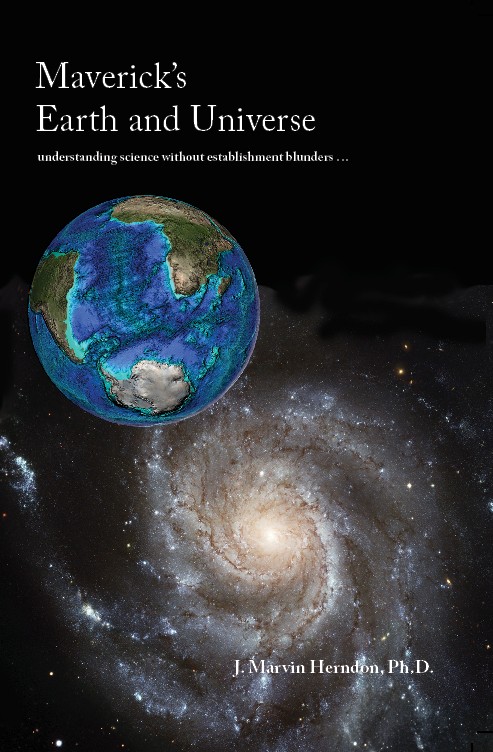
Reviews of Maverick's Earth and Universe |
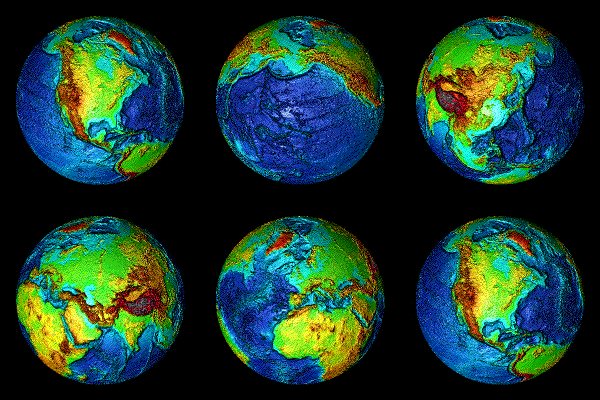
 This text is magnetized so that it attracts enquiring minds with its graceful language and humane Science insights and history! I found the same enjoyable stylistic parallels in THE MEDITERRANEAN WAS A DESERT, 1983, JOHN ISAACS AND HIS OCEANS, 1992, SECRETS OF THE ICE AGES, 2002 and ON THE CUTTING EDGE: TALES OF A COLD WAR ENGINEER, 2006. Herndon's viewpoint flows from the life of an active and obviously practical man,who seems to be utterly fascinated by every facet of an increasingly, if sometimes progressively halting, crystalization of Science. Herndon's too brief expose [page 49] of a tiny technical mistake that underpinned NASA's costly Moon forays by 1969 begs further elucidation! Some significant book features are the wonderful reproductions of famous scientists and others that fit logically with Herndon's account. However, I could not "see" a feature in Earth's topography said to be illustrated by an unnumbered map at page 181. This is a very enjoyable read, especially for a hot summer day, as the tone is exactly right for the subject and Herndon has managed to convey his ideas thoroughly and interestingly. I all my years (nearly 65) I've read many books on Science but not many can I say were truly enthralling. This is one of the few. -- by R. B. Cathcart
If you have any kind of
scientific curiosity, you will not be able to put this book down before
finishing it. This free thinking scientist offers alternate theories on
the topics I list below, and in parallel, criticizes the National
Science Foundation, the American Astronomical Society, and the flaws in
scientific method itself for delaying by decades the exposition of new
ideas that simplify our understanding of the universe. These are not
crackpot theories, and after reading this book, you will ask yourself,
"what have they been teaching us?". If you are interested in any of the
following, this book is a "must read". -- by Allyn Rothman
The evidence that there is a natural fission reactor in earth's core is considerable. Herndon makes his case, and does it well. It's fascinating reading. The implications are staggering, and many tenants of modern geology will have to be reexamined. He even presents an alternative theory to plate tectonics, and he makes a good case for a rather different model of planetary and solar system formation. No doubt he's right about the georeactor. The evidence is just too compelling to ignore. Loved this book. Can't wait to download the author's original papers and delve into the science more deeply. -- by J. J. Malone
Dr. Herndon's inquiring mind can reach to cosmic as well as earthbound ramifications in entertaining scientific fact-sets in a logical sequence. The geologic implications may offer us more immediate, and remediate, options, not only for "proof of concepts" but for utility in dealing with magnetic mysteries of the earth, and in understanding the sources and limitations of various fuels such as petroleum, while the cosmic implications may give us a less benign view of the appearance of the auroras (borealis and australis)at more temperate latitudes. I expect that he believes the world's end will come as a result of something not caused by mankind. It doesn't hurt us, and may help us a great deal, to learn to live more lightly on the earth in the mean time. In this effort we might leave galaxy-seeding to the stars and just try to keep our own planet fertile and habitable as long as we can and not waste and pollute earth for the sake of futile extraterrestrial voyages. I think Dr. Herndon agrees with this viewpoint, from his comment about the voyage of the US to the moon being misguided by an incorrect measurement which made the moon appear to be a treasure trove. -- by Alice D. Carmel
Maverick’s Earth and Universe is not a novel though written like one; nor is it a history of scientific discoveries but it uses them to explain concepts in easy terms; it is not a classical scientific book but it describes the Earth and the Universe with the vigor of real scientific thought; it is not an autobiography but it tells the fight one man had to shout out the truth he believes in, and above all it points the finger at the scientific system that wanted to be objective and independent and failed. It’s the obsession of a man who cries out his anger throughout the book almost wanting to breathe into his reader’s mind. I really enjoyed the book and recommend it to all. - by Franko Bonavia Maverick's Earth and Universe is available from Trafford (click here), from Amazon.com, (click here) and elsewhere. Italian translation by Franco Bonavia: La Terra e l’Universo (click here to download free pdf) Return to Home Page NuclearPlanet.com
|
